




CMA US Part 1: Financial Planning, Performance, and Analytics
How much is CMA US Part 1 coaching, and what does it cover?
Part 1 coaching at Global Fin X costs ₹25,000, with recorded lectures, live classes and doubt support — start any time. The exam is 4 hours: 100 multiple-choice questions plus two case-based questions. IMA fees are paid separately; take Part 2 with it in the Success Package. Individual students pay no GST.
Last reviewed by Sai Manikanta Pedamallu · October 2026
Syllabus Overview
Master the core concepts of financial reporting, planning, budgeting, and performance management.
External Financial Reporting Decisions (15%)
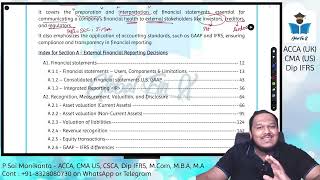
Covers financial statements, consolidation, integrated reporting, recognition, measurement, valuation, equity, revenue, and GAAP/IFRS differences.
Planning, Budgeting, and Forecasting (20%)
Includes strategic planning, budgeting concepts, forecasting techniques, and top-level planning and analysis.
Performance Management (20%)
Focuses on cost and variance measures, responsibility centers and reporting segments, and performance measures.
Cost Management (15%)
Deals with measurement concepts, costing systems, overhead costs, and supply chain management.
Internal Controls (15%)
Covers governance, risk, and compliance, systems controls, and security measures.
Technology and Analytics (15%)
Encompasses information systems, data governance, technology-enabled finance transformation, and data analytics.
Demo Lectures

- 01. CMA US Important Resources01:06:43
- 02. Complete Details about CMA Syllabus changes 2000:22:51
- 01. CMA US Part 1 Exam Guide- Structure, Pass Perc00:13:58
- 02. Mastering CMA US Part 1 - A Comprehensive Syll00:09:31
- 01. Sec A - External Financial Reporting Decisions00:16:14
- 01. Section A External Financial Reporting Decisio00:24:25
- 02. Sec A - IMP Topics00:10:50
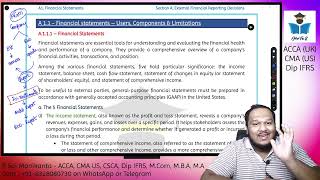
- A1. Financial Statements00:07:55
- A.1.1.1 – 1. Intro to FS00:11:55
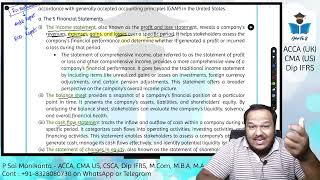
- A.1.1.1 – 2. 5 Financial Statements00:28:46
- A.1.1.1 – 3. Misc00:11:26
- A.1.1.2 - Users of financial statements00:09:06
- A.1.1.3 - 1. Income Statement00:41:15
- A.1.1.3 - 2. Balance Sheet00:41:50
- A.1.1.3 - 3. Cash Flow Statement00:54:28
- A.1.1.3 - 4. St of Changes in Equity00:49:31
- A.1.1.3 - 5. Notes to Accounts00:20:23
- A.1.1.4 - Connections in FS00:07:17
- A.1.2.1 - Consolidated FS00:51:06
- A.1.2.2 - 1. Three Types of Consolidations00:27:05
- A.1.2.2 - 2. Example00:09:34
- A.1.2.3 – 1. Acquisition Method00:21:02
- A.1.2.3 – 2. Goodwill00:18:19
- A.1.2.3 – 3. Consol at Aquisition00:37:33
- A.1.2.3 – 4. Post Acq and Adjustments00:46:57
- A.1.3.1 – Introduction 00:11:55
- A.1.3.2 - Purpose of Integrated Reporting00:07:27
- A.1.3.3 - Fundamental Concepts of Value Creation00:17:43
- A.1.3.4 - Elements of an Integrated Report00:09:50
- A.1.3.5 - Benefits and challenges00:12:58
- P1-A1-Revision-101:37:56
- P1-A1-Revision-201:07:14
- P1-A1-Revision-302:21:36
- A.2.1.1 - 1. Intro to AR00:10:09
- A.2.1.1 - 2. Measurement00:06:50
- A.2.1.1 - 3. Discounts00:32:31
- A.2.1.1 - 4. Allowance for Bad Debts00:33:23
- A.2.1.1 - 5. Accounting Entries00:12:44
- A.2.1.1 - 6. Factoring00:21:58
- A.2.1.2 – 1. Inventory00:13:11
- A.2.1.2 – 2. Special Items of Inventory00:20:14
- A.2.1.2 – 3. Periodic vs Perpetual Systems00:19:06
- A.2.1.2 – 4. Cost Flow Assumptions00:17:47
- A.2.1.2 – 5. FI-FO00:21:22
- A.2.1.2 – 6. Weighted Avg00:36:54
- A.2.1.2 – 7. LIFO Basics00:18:58
- A.2.1.2 – 8. LIFO Periodic and Perpetual00:22:53
- A.2.1.2 – 9. Summary of all Methods00:06:31
- A.2.1.2 – 10. Comprehensive Problem00:36:04
- A.2.1.2 – 11. Valuation of Inventory00:24:06
- A.2.1.2 – 12. Cost, NRV and Maket00:28:08
- A.2.1.2 – 13. Invetory Errors00:24:59
- A.2.1.2 – 14. US GAAP vs IFRS00:02:16
- A 2.2 - Non-Current Assets valuation00:06:50
- A.2.2.1 - 1. Property, Plant, and Equipment00:05:29
- A.2.2.1 - 2. Initial Measurement00:12:23
- A.2.2.1 - 3. Borrowing Costs00:40:30
- A.2.2.1 - 4. Subsequent Measurement00:09:47
- A.2.2.1 - 5. Capital vs. Revenue Expenditures00:07:12
- A.2.2.1 - 6. Depreciation - Basics00:23:52
- A.2.2.1 - 7. Depreciation Methods00:31:29
- A.2.2.1 - 8. Summary and Problem00:24:35
- A.2.2.2 - 1. Intro to Intangible Assets00:13:31
- A.2.2.2 - 2. Accounting Intangible Assets00:20:09
- A.2.2.2 - 3. Specific Intangible Assets00:20:29
- A.2.2.3 – 1. Impairment Intro00:06:35
- A.2.2.3 – 2. Impairment Calculation00:15:58
- A.2.2.3 – 3. IFRS Impairment and Problem00:16:00
- A.2.2.3 – 4. Indefinite Life assets00:09:12
- A.2.2.3 – 5. Goodwill Impairment00:20:13
- A.2.2.4 - 1. Investments in Debt Securities00:13:27
- A.2.2.4 - 2. Classification of Debt Sec00:19:05
- A.2.2.4 - 3. Valuation of Debt Sec00:19:47
- A.2.2.4 - 4. HTM Amortized Cost Model00:21:21
- A.2.2.4 - 5. Impairment of Debt Sec00:31:16
- A.2.2.5 - 1. Equity Securities00:06:33
- A.2.2.5 - 2. Classification00:08:29
- A.2.2.5 - 3. Valuation00:08:08
- A.2.2.5 - 4. Impairment00:05:13
- A.2.2.5 - 5. Sale of Equity and Problem00:19:59
- A.2.2.5 - 6. Equity Method00:08:49
- A.2.2.5 - 7. Summary00:06:32
- A.2.3.1 – 1. Liabilities00:08:22
- A.2.3.1 – 2. Trade Accounts Payable00:27:20
- A.2.3.1 – 3. Contingencies00:18:12
- A.2.3.1 – 4. Warranties00:20:16
- A.2.3.2 - 1. Leases Intro00:14:00
- A.2.3.2 - 2. Classification Test00:11:03
- A.2.3.2 - 3. Initial Recognition00:24:20
- A.2.3.2 - 4. Subsequent Finance Leases00:25:35
- A.2.3.2 - 5. Finance Leases Problem00:23:31
- A.2.3.2 - 6. Operating Leases00:24:11
- A.2.3.2 - 7. Short Term Leases00:03:29
- A.2.3.3 - 1. Income taxes00:22:08
- A.2.3.3 - 2. Tax Allocation00:07:19
- A.2.3.3 - 3. Temporary and Permanent Differences00:12:43
- A.2.3.3 - 4. Deferred Taxes00:35:41
- A.2.3.4 - 1. Bonds Payables00:13:09
- A.2.3.4 - 2. Bond Issuance00:27:45
- A.2.3.4 - 3. Amortization of Premium or Discount00:17:28
- A.2.3.4 - 4. Journal Entries00:21:11
- A 2.4 - Revenue recognition - Intro00:03:35
- A.2.4.1 - Revenue from Contracts with Customers01:14:17
- A.2.4.2 - 1. Recognition of Revenue over Time00:38:18
- A.2.4.2 - 2. Practice Problem00:07:47
- A.2.4.2 - 3. Recap and Problem00:13:45
- A.2.4.2 - 4. Netting Off00:06:46
- A.2.4.3 - Matching Principle00:06:37
- A.2.5.1 – 1. Issuance of Stock00:13:24
- A.2.5.1 – 2. Treasury Stock00:16:38
- A.2.5.1 – 3. Cash Dividend00:05:25
- A.2.5.1 – 4. Property Dividend00:04:00
- A.2.5.1 – 5. Stock Dividends00:09:53
- A.2.5.1 – 6. Stock Splits00:11:09
- A.2.6.1 - 1. GAAP vs. IFRS00:20:05
- A.2.6.1 - 2. GAAP vs. IFRS00:16:44
- A.2.6.1 - 3. GAAP vs. IFRS00:07:02
- 01. Sec B - Planning, Budgeting, and Forecasting00:17:01
- B.1.0. Business 10100:16:20
- 02. Mission, Vision and Strategy00:18:38
- 03. Levels of Planning00:25:30
- 04. External and Internal factors00:16:06
- 05. Tactical and Operational Plans00:11:47
- 06. Porters Generic Strategies00:17:17
- 07. SWOT Analysis00:27:02
- 08. Porters 5 Forces00:26:25
- 09. PEST Analysis00:17:59
- 10. Other Planning Tools00:16:47
- 11. BCG Matrix00:31:04
- 12. BCG - Apple00:15:12
- B.2.1 - Budgeting 00:15:47
- B.3.0 - Forecasting techniques00:11:13
- B.3.1.1 – Understanding Linear Regression00:09:35
- B.3.1.2 - 1. Simple Regression00:22:21
- B.3.1.2 - 2. Elements of Regression00:24:27
- B.3.1.3 - Multiple 00:09:51
- B.3.1.4 - Benefits 00:08:10
- B.3.2.1 - Time Series Analysis00:29:15
- B.3.3.1 - Sensitivity Analysis00:16:38
- B.3.3.2 - Simulation00:25:10
- B.3.4 - Smoothing00:48:29
- B.3.5 – Learning Curve00:31:26
- B 3.6 – Expected Value Analysis00:19:44
- B.4. Budget methodologies_compress_lv200:09:32
- B.4.1 - Project Budgeting_compress_lv200:17:53
- B.4.2 - Activity-Based Budgeting (ABB)_compress_lv00:15:59
- B.4.3 - Zero-Based Budgeting (ZBB)_compress_lv200:10:24
- B.4.4 - Continuous (Rolling) Budgeting_compress_lv00:11:12
- B.4.5 - Flexible Budgeting_compress_lv200:11:56
- B.5. Annual profit plan and supporting schedules00:19:19
- B.5.1.1 – Understanding Master Budgets - 100:20:04
- B.5.1.1 – Understanding Master Budgets - 2 Flow Ch00:14:21
- B.5.1.2 - Operating Budgets - 1 Sales00:21:58
- B.5.1.2 - Operating Budgets - 2 Production00:09:29
- B.5.1.2 - Operating Budgets - 3 RM00:27:47
- B.5.1.2 - Operating Budgets - 4 DL00:11:02
- B.5.1.2 - Operating Budgets - 5 OH00:07:27
- B.5.1.2 - Operating Budgets - 6 FG Inv00:11:04
- B.5.1.2 - Operating Budgets - 7 COGS00:18:06
- B.5.1.2 - Operating Budgets - 8 NonMFG00:08:02
- B.5.1.2 - Operating Budgets - 9 Proforma OI00:05:10
- B.5.1.2 - Operating Budgets - 10 Misc00:12:05
- B.5.1.3 – Financial Budgets - 1 Capex00:07:26
- B.5.1.3 – Financial Budgets - 2 Cash Collections00:28:15
- B.5.1.3 – Financial Budgets - 3 Cash Disbursements00:17:42
- B.5.1.3 – Financial Budgets - 4 Cash Budget00:15:36
- B.5.1.3 – Financial Budgets - 5 Misc00:06:59
- B.6. Top-Level Planning and Analysis00:03:02
- B.6.1.1 – Proforma Financial Statements00:13:06
- B.6.1.2 - Pro Forma Income Statement00:16:39
- B.6.1.3 - Pro Forma Balance Sheet00:10:49
- B.6.1.4 - Pro Forma Statement of Cash Flows00:07:10
- B.6.1.5 - Relationship Among Pro Forma Financial S00:07:18
- B.6.1.6 - Factors for Medium- and Long-Term Cash F00:06:10
- B.6.1.7 - Financial Projections for Financing and 00:20:43
- 01. Sec C - Performance Management00:14:33
- 01. Intro to Performance Management00:18:50
- 02. Master Budgets and Variances00:34:35
- 03. Flexible Budgets, Volume and Flexible variance00:23:24
- 04. Sales Price and Volume Variances00:25:35
- 05. Sales Mix Variance00:24:10
- 06. Management by Exception00:06:13
- 07. Standard Costing00:17:56
- 08. Material Variances00:24:39
- 09. Material Mix and Yield Variances00:32:23
- 10. Practice Question on Material Mix 00:09:21
- 11. Labour Variances00:14:05
- 12. Labour Mix and Yield Variances00:12:55
- 13. Practice Question on Labour Mix 00:12:42
- 14. Relationships between Variances00:06:03
- C2. Responsibility centers and reporting segments00:12:47
- C.2.1.1 - Responsibility Centers_compress_lv200:19:11
- C.2.1.2 – Contribution Margin_compress_lv200:22:56
- C.2.1.3 - Segment Reporting 00:21:41
- C.2.1.4 – Segment performance evaluation00:25:56
- C.2.2.1 - Transfer Pricing00:29:40
- C.2.2.2 - Methods for Determining Transfer Prices00:27:50
- C.2.2.3 – Other aspects of Transfer Pricing00:21:17
- C 3.1 – Financial Performance Measures00:14:17
- C.3.1.1 - Performance Measures00:19:01
- C.3.1.2 - 1. ROI00:28:41
- C.3.1.2 - 2. RI00:16:32
- C.3.1.2 - 3. ROI vs RI00:05:13
- C.3.1.3 - Product, Business Unit, and Customer Pro00:15:03
- C.3.1.4 – Other Factors 1. Strategic and Operation00:15:57
- C.3.1.4 – Other Factors 2. Policies00:16:43
- C.3.1.4 – Other Factors 3. Inv, Assets00:07:49
- C.3.2.1 – 1. NFPM00:18:59
- C.3.2.1 – 2. CSFs and KPIs00:09:20
- C.3.2.2 – Balanced Scorecard-1. BSC00:16:56
- C.3.2.2 – Balanced Scorecard-2. BSC00:10:02
- C.3.2.2 – Balanced Scorecard-3. Strategy Map00:05:38
- 01. Sec D - Cost Management00:19:25
- 02. Instructions for Sec D00:07:23
- 01. Cost Object 00:19:45
- 02. Product vs Period Costs00:11:04
- 03. Direct, Indirect, Prime vs Conversion Costs00:10:40
- 04. Fixed and Variable with Graphs00:37:42
- 05. High Low Method00:09:35
- D.1.4.1 - Actual Costing00:16:39
- D.1.4.2 - Normal Costing00:12:59
- D.1.4.3 - Standard Costing Systems00:22:47
- D.1.4.5 - Backflush Costing00:16:46
- D.1.5 – Intro Story00:21:36
- D.1.5.1 - Absorption Costing00:22:23
- D.1.5.2 - Variable Costing00:21:22
- D.1.5.3 - Absorption vs Variable 100:32:04
- D.1.5.3 - Absorption vs Variable 200:15:47
- D.1.6.1 - Joint & By Products00:13:29
- D.1.6.2 - 1.Physical Measure Based00:12:43
- D.1.6.2 - 2.Market-Based Approaches00:23:24
- D.1.6.2 - 3.Comprehensive Question00:13:18
- D.1.6.3 - By Products00:15:19
- D.1.7.1 – CoGM and CoGS00:29:16
- D.2.1.1 – Job Costing Introduction 00:13:46
- D.2.1.3 - Job-Order Costing 1-Process00:15:55
- D.2.1.3 - Job Order Costing 2-Example00:03:08
- D.2.1.4 - Spoilage, Rework, and Scrap00:23:23
- D.2.1.5 - Benefits and Limitations of Job-Order Co00:07:38
- D.2.2.1 – Process Costing00:10:25
- D.2.2.3 - Equivalent Units of Production00:14:10
- D.2.2.4 - Key Terms00:12:04
- D.2.2.6 - Benefits and Limitations00:05:45
- D.2.3.1 - Overview of ABC00:28:01
- D.2.3.2 - Comparison Aborption vs ABC00:18:59
- D.2.3.3 – Comprehensive Question00:21:27
- D.2.3.4 - Process Value Analysis00:12:40
- D.2.3.5 - Evaluation of ABC00:06:06
- D.2.3.6 - ABC in Service Organizations00:09:11
- D.2.3.7 - Over Absorption and Under Absorption00:09:29
- D.2.4.1 - Life-Cycle Costing00:27:28
- D.2.5 – Summary of Costing Methods00:10:51
- D3. Overhead Costs00:05:40
- D.3.1 - Variable and Fixed Overhead00:13:30
- D.3.2- Overhead Allocation Methods00:29:32
- D.3.3.1 - Service Departments00:08:50
- D.3.3.2 1 - 3 Methods Problem00:25:09
- D.3.3.2 2 - Practice Question00:15:42
- D.3.3.3 - Dual Rate Allocation00:05:50
- D.4. Supply Chain Management00:07:04
- D.4.1 - Supply Chain Management-100:16:51
- D.4.1 - Supply Chain Management-200:12:59
- D.4.2.1 - Introduction to SCM Strategies00:04:51
- D.4.2.2 - Just-in-Time (JIT) Inventory Systems - 100:21:13
- D.4.2.2 - Just-in-Time (JIT) Inventory Systems - 200:15:55
- D.4.2.3 - Lean Resource Management00:19:11
- D.4.2.4 - Outsourcing00:26:04
- D.4.3.1 and 2 - MRP and MRP II00:22:16
- D.4.3.3 and 4 - ERP and ERP II00:20:27
- D.4.4.1 - Theory of Constraints00:16:22
- D.4.4.2 - Throughput Costing00:09:42
- D.4.4.3 - Scenario on TOC and Throughput00:07:06
- D.4.5.1 - Capacity Levels00:12:54
- D.4.5.2 - Capacity Planning-100:14:30
- D.4.5.2 - Capacity Planning-200:12:46
- D.5.0. Business Process Improvement00:05:41
- D.5.1 – BPI Introduction 00:07:39
- D.5.2 - Value-Chain Analysis-100:19:13
- D.5.2 - Value-Chain Analysis-200:17:16
- D.5.2 - Value-Chain Analysis-300:16:12
- D.5.2 - Value-Chain Analysis-400:07:25
- D.5.3 - Process Analysis-100:20:30
- D.5.3 - Process Analysis-200:14:22
- D.5.4-BPR00:21:04
- D.5.5 - Best Practice Analysis00:22:38
- D.5.6 - Continuous Improvement00:22:44
- D.5.7 - Costs of Quality-100:03:55
- D.5.7 - Costs of Quality-200:09:14
- E.0.1. Sec E - Internal Controls00:12:55
- E.0.2. Introduction to Sec E00:05:01
- E.1.1. Governance, BOD, Audit Committee 00:38:52
- E.1.2. SOX Act 200200:28:45
- E.1.3. FCPA 197700:05:46
- E.1.4.1 - 1. Intro to Audit00:21:17
- E.1.4.1 - 2. External Auditor Responsibilities00:09:41
- E.1.4.2. Reasonable Assurance00:08:43
- E.1.4.3 - 1. Phases of Audit 00:07:15
- E.1.4.3 - 2. Audit Risk 00:27:55
- E.1.4.3 - 3. Audit Evidence 00:13:58
- E.1.4.3 - 4. Audit Opinions00:34:23
- E.1.4.3 - 5. Other paragraphs and Revision00:17:04
- E 1.5 - Integrated Audit00:20:32
- E.1.6.1 - Internal Controls00:15:54
- E.1.6.2 - Internal Control Categories00:20:33
- E.1.6.3 - Key Control Activities00:17:45
- E.1.6.4 - Internal Control Risk00:31:12
- E.1.7.1 – The Committee of Sponsoring Organization00:18:25
- E.1.7.2 – Objectives in the COSO Framework00:09:40
- E.1.7.3 – Entity Dimension00:11:00
- E.1.7.4 - CRIME 100:19:34
- E.1.7.4 - CRIME 200:12:57
- E.1.7.4 - CRIME 300:14:10
- E.1.8 - Role of the PCAOB in Auditing Internal Con00:18:15
- E.2.1.1 - Systems Controls and Information Securit00:14:52
- E.2.1.2 - 1. Access Controls00:19:59
- E.2.1.2 - 2. System Threats Internal00:19:11
- E.2.1.3 - 1. Input Controls00:36:28
- E.2.1.3 - 2. Processing Controls00:16:07
- E.2.1.3 - 3. Output Controls00:07:27
- E.2.1.3 - 4. Storage Controls00:30:33
- E.2.1.4 - a. External Threats00:25:03
- E.2.1.4 - b. Overview of Mitigation Strategies00:07:08
- E.2.2.1 – Physical Controls00:17:10
- E.2.2.2 - Protecting Programs and Databases00:12:28
- E.2.2.3 - Internet vs. Secured Transmission Lines00:28:34
- E.2.2.4 - Data Encryption00:12:44
- E.2.2.5 - Firewalls and Their Uses00:22:14
- E.2.2.6 - Flowcharts of Activities00:08:05
- E.2.2.7 - Segregation of Accounting Duties00:11:17
- E.2.3.1 - Importance of Regular Backups and Secure00:17:31
- E.2.3.2 - Business Continuity Planning vs Disaster00:19:44
- E.2.3.3 - Dealing with Specific Types of Disasters00:06:03
- E.2.3.4 - Disaster Recovery Plan 00:18:24
- E.2.3.5 - Advantages and Disadvantages of DRP and 00:03:37
- F.0.1. Sec F - Technology and Analytics00:14:56
- F.0.2. F1 to F4 Intro00:06:17
- F.1 - Accounting Information System (AIS)00:30:26
- F.1.2 - AIS (Business) Cycles00:11:33
- F.1.3 - Separate Financial 00:09:08
- F.1.4 - Enterprise Resource Planning (ERP)00:10:44
- F.1.5 - Database Management Systems (DBMS)00:31:43
- F.1.6 - Data Warehouse 00:08:39
- F.1.7 - Enterprise Performance Management (EPM)00:10:49
- P1-F1-Revision00:44:13
- F.2.0 - Introduction to F200:06:50
- F.2.1 - Data Management and Data Governance00:16:24
- F.2.2 - COSO Internal Control - Integrated Frame00:16:52
- F.2.3 - Data Life Cycle 00:31:27
- F.2.4 - Archiving and Record Retention00:07:07
- F.2.5.1 - Cyber Attacks 00:23:54
- F.5.2 - Thwarting Cyber Attacks00:30:18
- P1-F2-Revision00:47:49
- F.3.0. Intro to F3 Topic00:05:27
- F.3.1 - System Development Life Cycle00:20:38
- F.3.2 - Business Process Analysis 00:10:56
- F.3.3.1 - Artificial Intelligence 00:22:18
- F.3.3.2 Business Process Automation and RPA00:23:10
- F.3.4 - Cloud Computing 00:29:04
- F.3.5 - Blockchain00:24:50
- F.3.5.2 Advantages, Disadvantages and Applications00:09:40
- F.3.5.3 Smart Contracts with Examples00:15:09
- P1-F3-Revision01:10:41
- F.4.0. Intro to F400:06:38
- F.4.1.1. Business Intelligence00:27:11
- F.4.1.2. Intro to Big Data00:12:13
- F.4.1.2. 4Vs of Big Data00:27:31
- F.4.1.2. Benefits, Challenges and Data Fusion00:09:18
- F.4.1.3 - Data Structure00:08:24
- F.4.1.4 - Data Progression00:07:58
- F.4.1.5 - Data Science uses and Limitations00:08:28
- F.4.2.1 - Data Mining00:17:35
- F.4.2.2 - Challenges with Data Mining and Data Ret00:11:50
- F.4.3.1 - Data Analytics00:31:24
- F.4.3.2 - Process of Data Analytics00:13:36
- F.4.3.3 - Types of Data Analytics00:07:11
- F.4.3.4 - Types of Analytic Models00:14:19
- F.4.3.5 - Challenges and Limitations00:13:52
- F.4.4.1 - Data Visualization00:07:08
- F.4.4.2 - Benefits and Limitations00:06:09
- F.4.4.3 - 1. Various Visualizations00:42:16
- F.4.4.3 - 2. To Dos for Data Visualization00:10:35

Meet Your Tutor
Sai Manikanta Pedamallu
CMA (US), ACCA (UK), CSCA (US), Dip IFRS, AFA (UK), MIPA (Aus), M.Com, M.B.A
Sai Manikanta Pedamallu is a highly-rated CMA US Instructor and Dip IFRS Trainer with over a decade of experience in finance and education. He holds extensive qualifications, including CMA (US), ACCA (UK), CSCA (US), and Dip IFRS. In the corporate world, he serves as an ERP Product Manager and Finance Controller. Known for his dynamic teaching and practical insights, he empowers students to excel in global finance qualifications and consistently receives high student ratings.
Start Learning Now
₹25,000
This Course Includes:
- Learn from a Qualified CMA Instructor.
- Pre-recorded content accessible via laptop, PC, Android mobiles, Android Tabs, iPhones, and iPads.
- 3X Views with 6 Months validity by default. Extension provided if needed (free or chargeable based on reason).
- 24*7 tutor support on Telegram and WhatsApp.
- Soft copies of Materials provided within the Course fee.
- Digital Class Notes – Shared as PDF Files via Google Drive.
- Student shall be added to the telegram group of the subject after enrollment.